
Between the Swamp and Oblivion
Shell-building cultures and bad universalisms at Miami art week

The boarding area at LaGuardia is full of art world people: over-styled Boomers and Gen Xers, wired Millennials, and the confused civilians slowly realizing that they’ve chosen the wrong flight. The art people smile and wave and brace themselves for Miami; it’s art week, and all the routine evaporations of time and money into the white sand and paint and white canvases. The status-havers bumrush the priority boarding lanes. The gate agent makes a scolding, exasperated announcement. How could adults, especially such chic ones, behave like this? It’s a strange mix of business trip and school outing. Aesthetic track meet. On their phones, people are stretching.
On the plane, I am listening to a political and intellectual history of the Americas post-conquest, America, América by Greg Grandin. It’s a hopeful chapter after a century of North American domination, where Roosevelt and company put forward their Good Neighbour policy. For a brief moment, it outlined a universalism, materializing the centuries-long progressive hope that the Western Hemisphere could enter into a true unit that could respond dialectically to the “Old World” – an idealist fantasy ended by the frisson of the former colonies, with the imposition of Nazism and lesser fascisms through the ethnic loyalty bubbling up all over. One of many Nazi dispersals.
This hemispheric vision presented a pan-American identity as an avenue of ideology. A universalizing identity politics based in abstraction but tied to the map. Doomed to fail with all the competing isms of the 20th century, with economic inequality among and between the nations.
I watch the small screen in the seat back as it shows information about the Black River, which merges into the Great Pee Dee River in South Carolina. I let my mind move over the exchange of the original Wee Nee to Black over the course of colonialism. Delta has, I assume, acquiesced to some demand by Trumpist regulators and labeled the large body of water hugged by the twin arms of Florida and Yucatan as the Gulf of America, with Gulf of Mexico in whimpering parentheses. The whole fuss could have likely been solved by calling it the Gulf of América.
In Miami, the pressures of representation fade away. Everything is modulated by the alternating booths of stark white with their algorithmic mix of spray-paint-neo-pop-art and folky, identity-conscious neo-expressionism. A billboard devoid of irony promotes STD tests in cursive pink neon as we sit and wait in the interminable traffic. Apparently, the water taxis are free this year, but no one can confirm, except for one writer who tells me it was scenic, and surprisingly efficient. Everyone around cheers at this, holding up their cosmopolitan sensibilities against the concrete infrastructure of the pleasure town.
I have a recurring dream where a divine wave descends on Miami Beach during art week, sweeping billions of dollars of artwork and equipment out into the sea. For some reason, the dream is less violent than it could be, no people seem to be present at all, just the deluge, the wave and the floating bits of dayglo and paper in the sea, washing about in the waves in a psychedelic whirlpool of climatic retribution, value erased, Kwades and Koons sinking to the bottom, decorating the bizarre Reefline, a project where they are building underwater structures in the form of sculpture and mini cities to create new ecosystems for marine life. Good intentioned, I cannot help but imagine actual cities underwater as the condition for the return of vibrant marine life. I’m unconvinced, as always, that art without a social basis can facilitate any sort of change, so we are left with irony, and in Miami, the people are also drowning in irony.
An American says they can’t believe they have to be in Florida again, framing Miami as an outpost against the sweaty revanchism of the rest of the state, a begrudging concession. A European says they want to go to the Everglades, to see the “rest of America,” but they are scared. In New York, the “rest” of America feels far away, but in Miami, everything seems close, America in general, from the Caribbean to the West Coast. There are only two honest American cities, a neon-blue-haired Sengalese musician muses on a canal-side dock on one of the artificial islands spread out across the water, Miami and Las Vegas.
Someone tells me that their Uber driver complained the whole interminable length of an interminable gridlocked bridge trip. They complained about New Yorkers ruining Miami. New Yorkers being, perhaps, a shorthand for art people. And they do seem to be doing penance. Getting their hands dirty away from the clean sophistication of New York or Paris or London. Art often goes the way of the mafia.
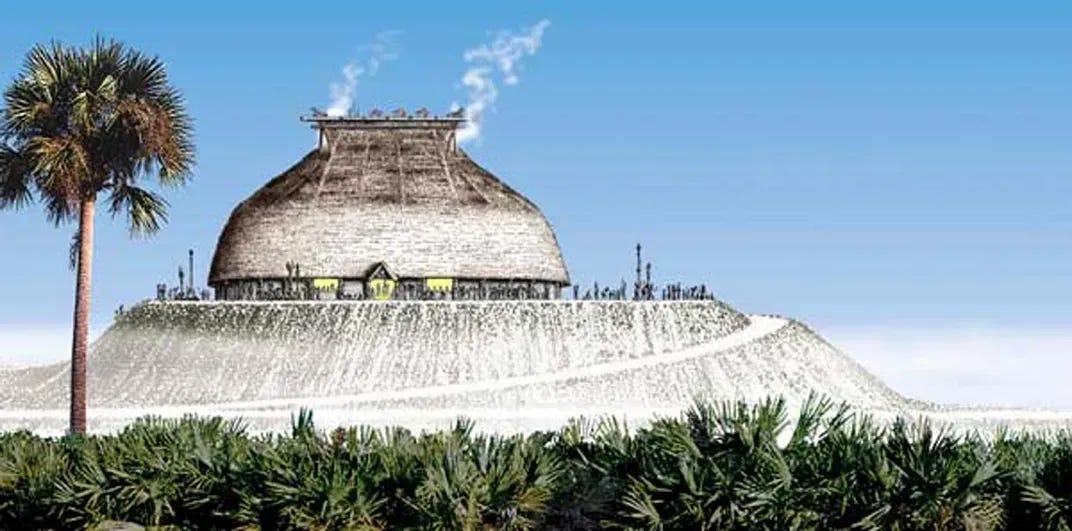
Apparently, the Calusa peoples who inhabited the Everglades and beaches of south-eastern Florida before the Spanish came, vacating long before Andrew Jackson drove the Seminoles there, had a hierarchical social system strangely complex for a non-agricultural people. Archaeologists have found massive mounds of shells left behind by these people, and assume that they were ways of dividing space, marking territories, and even providing defense and base infrastructure for inhabitants. They were even used as the base for whole islands.
Anthropologist Victor Thompson writes that “[t]he Calusa were an incredibly complex group of fisher-gatherer-hunters who had an ability to engineer landscapes. Basically, they were terraforming.”
“China creates islands. Dubai creates islands,” he continues, “The Calusa created islands.”
Maybe the Calusa built Art Basel before Switzerland was even wrested from the Habsburg midcenturies. Maybe they built Dubai. Maybe, if left alone, they too would have created the blockchain, inspired by the decentralized mangroves and swirling eddies of the eternal swamp. But the crypto creatures that dominated Miami just a few years ago seem to have also disappeared, leaving behind empty party venues and fair goers hungry for LEDs and free booze.
Someone remarks that they were appalled by the intensity of a group of anti-communist Cubans at a party, who found common cause with some Anglos from New York in their aggression. One forgets that Florida is a refuge of another sort in this way. It’s unclear if the Europeans know this at all. Art, here, does have some sort of universalizing tendency, the white-wall gallery a blank space to project values, even if those values have become so confused with commodity, which is a sort of universalism. People cling to the idea of Miami art week exactly because it is this blank space between the threat of the sea and the historical swamp. The dance party, too, has some universalising tendency. The event as a breakage in time captured, for now, by the market, linked to the cosmopolitan world system of which Miami is, maybe reluctantly, a part. But, as it’s always been, this internationalism is an elite one.
Despite its tacky grandeur, maybe Miami has become such a hub for the event because of its indeterminacy. It’s neither Anglo American nor Latin American, it’s neither Florida nor the Caribbean, it’s neither city nor resort.
But as Joshua Citarella has noted, this universalism is already breaking down in a multi-polar world of new blocs and tariffs. Miami, existing outside of any pure designation, besides, of course, the federal legal regime, seems to shirk some of the moral constraints of gallery scenes in more liberal states.
Does this mean that Miami can exist in the older, neoliberal, free-moving scene because of and not in spite of its presence in anti-woke Florida? One witnesses both the uninhibited movement of “cancelled” individuals and the full-voice reading of bell hooks on speakers at Ed Devlin’s beach installation. Like the power of the Special Economic Zone for physical goods and services, maybe we are seeing the establishment of anti-woke zones, competing for fairs by presenting themselves as outside of the national battles. Florida has been presenting itself for years as an anti-woke bastion.
The cosmopolitanism of art, its international tendencies and universalizing potential can just as easily become vehicles for marketing, exposing people to cities, other people, opportunities; the event as mixer and not as exposure. Anyone who has confidence in the potential for raising consciousness through something as abstract as contemporary art has spent too much time online and not enough on Collins Boulevard.
“I don’t like to look at anything. This is social for me,” someone says as we walk the interminable polished concrete floors of Art Basel’s gallery floor, somewhere between Beeple’s robotic dogs with silicon masks of Musk and Bezos and a collection of Man Ray negatives. The event grips and leaves its archaeological remnants, but at its base, it is a social accelerator. Money and names interchanging under the guise of art. The waves lap in the distance, something smolders. Someone calls their banker, drunk, informing them of an impending withdrawal. An orthodox child picks up a shell on the beach, and her dad asks the beach attendant, an East African named Roosevelt, what the big tents are for.